
I got this from Victor on twitter
Collaborative intelligence is more important than collective intelligence. Collective intelligence taps the consensus “wisdom of crowds” and harnesses algorithms to transform diverse input into a better-than-average consensual output. Collaborative intelligence taps the diversity of individuals, manifesting principles of evolutionary design to adapt to continually changing ecosystems.
Showing posts with label Collective Intelligence. Show all posts
Showing posts with label Collective Intelligence. Show all posts
Sunday, March 22, 2009


Thursday, August 07, 2008
Co-creation is in fashion

I have always been a huge fan of co-creation and I have just been checking out on of future laboratory's THE magazine and found another cool business model around co-creation called WEARE.... pronounced 'wear' . Which is a crocreated fashion label. Supposedly they are talking with Savile Row to integrate co-creation into the traditional tailoring sector. Interesting
Monday, May 12, 2008
Co-Creation Companies
On from my post about brand using co-creation. I found a company over at RMM London that is all about bringing seekers and solvers together over at Innocentive. Thats pretty cool
Wednesday, April 30, 2008
The real reason we are watching less tv.. cognitive surplus
I got this over at Neil's Only Dead Fish as well (he is having a great week). Cognitive surplus.. brillant
Great Creativity Everywhere

The one thing I love about the internet. Is that I continually find really creative stuff from all walks of life and the great thing is people love sharing it. I guess the internet gives you a different kind of validation for what you do.
I saw a really interesting article in Wired about a competition that Netflix has that challenges people to beat their algorithm by 10% and you get a million dollars. The really interesting thing is the two parties leading, are from completely different fields. One the usual techy group and the other who is a pyschologist and is getting his daughter a university student to build the code.
Monday, April 28, 2008
Co-Creation is the way forward

I have really been into the whole collective intelligence and the use of co-creation for a while. It sounds fantastic and makes sense but I am starting to see and hear of more and more great examples which make it more real. I was at the IPA Strategy debate today (I will write more soon) and heard of a few more. I think this is a really interesting way of what I call 'opening the ivory tower' that big companies seem to live in. So I thought I would list out a couple that I liked.
Starbucks: although I hate starbucks and their whole model. Supposedly some people do. So their input is starting to be heard at the company.
Incentive : is a program P&G developed in 2005 after the CEO stated in the future he wanted 50% of his innovation to come from outside the company. Supposedly 90,000 people are involved compared to the 7,500 they have in their R&D division world wide. It supposedly has made them launch 137 products. One of which is the international Olay Regenerist. I will try and find a website for it.
Dellideastorm: this is an interesting one that Dell created off the back of their issues with their batteries that started catching fire a few years back. This was a great way to turn the issue on its head and open up the company to comments and also innovation.Legofactory: I was a great lover of lego as a kid. Also as I have grown older, I have started to gain a macho need to build something. So the great guys at Lego realised that the digital world was going to kill their business. So they asked the public for their help and the factory was built online. They have also used it to start building products that they are putting into stores as well.
Boots17: I think this is a great one, as although online co-creation is awesome at this stage in its life cycle (for lack of a better word) you have to utilise it for the appropriate audience and appropriate reason. Teenage audience on myspace for this brand is perfect. Teenagers want to express themselves through their creativity... (reason why myspace is full of them) and also having their names on the actual products is a huge amount of 'egoboo' a term used in the social networking world. Which is when you boost a users ego.
So there are a few great examples of co-creation. There are a number of areas that make this interesting which are:
- Cheap research: having access to people at any time needed
- Cheap R&D: why pay for a number of experts when you can have thousands of people who dont do it for money
- Truly putting the consumer at the heart of the business
- Advocacy: the hawthorne effect that was highlighted in research that dates back to productivity in a factory in the 20's and 30's, highlighted that getting people involved in the process increased their appeal towards it because of the respect placed on their opinion. This is a great way to deliver advocacy of your brand
Wednesday, April 16, 2008
My love for Collective Intelligence
This is a great video from TED on the opensource economy and utilising collective intelligence.
Tuesday, November 28, 2006
Collective Intelligence
After scouring a lot of different blogs and starting my own. I am starting to get caught up in this world of 'collective intelligence' and new sharing styles of technology that is driving towards this paradigm shifting era. Organic Frog had a great post the other day which has led me to chase some more information down. There are a couple of great articles on how from a technical point of view how you can make this happen.
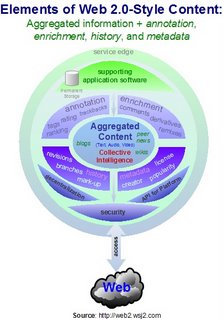
Dion Hinchcliffe has written five great ways to harness collective intelligence. Its a great run through. But its more about the technology of the side.
I have also found an article that is more interesting, as it shows how this development in technology can feed a completely different style of business in the new knowledge driven commercial world. Its from George Por who is regarded as one of the pioneers of CI. In his article Quest for Collective Intelligence he highlights the need for a strong community nervous system that will enable collective intelligence to drive business prosperity. By ‘electrifying’ this nervous system you create an infrastructure that will self organise and self improve the community’s collective intelligence. It was written ten years ago and doesnt take into account all the new sharing technology that is becoming mass.
There are four key areas to developing this nervous system:
1.Communication: using all elements of communication and both virtual and physical. Then logging them all on a server or host to allow everybody to access and add to within timeframes that are flexible.
2.Coordination: Evolving company processes and systems as everyone’s open involvement will drive a greater efficiency and way of working.
3.Memory/Knowledge Management: to support a sense of collective identity and develop the community's learning by enabling rapid sharing of recorded experiences and other knowledge resources.
4.Learning: The company and participants need to commit resources, clearly articulate and periodic re-assess the community's short and long term learning needs as apart of a continual learning company ethic.
If anyone has anything else on this. I'd love to see it
Subscribe to:
Posts (Atom)


 Posts
Posts


